Molly is a street name for MDMA, short for 3,4-methylenedioxymethamphetamine. Ecstasy is another common name associated with the same drug. The National Institute on Drug Abuse lists both Molly and Ecstasy as names for MDMA, a synthetic substance with stimulant-like effects that can also alter perception.
Where the answer gets more complicated is the illicit market.
Something sold as “Molly” is supposed to contain MDMA, but the name does not tell you what is actually in a powder, capsule, or tablet. Testing of substances sold as MDMA has found other drugs and adulterants, sometimes without the person taking them knowing.
So chemically, Molly and MDMA refer to the same intended drug. In practice, a street product labeled Molly cannot be assumed to contain pure MDMA—or even MDMA at all.
Key Takeaways
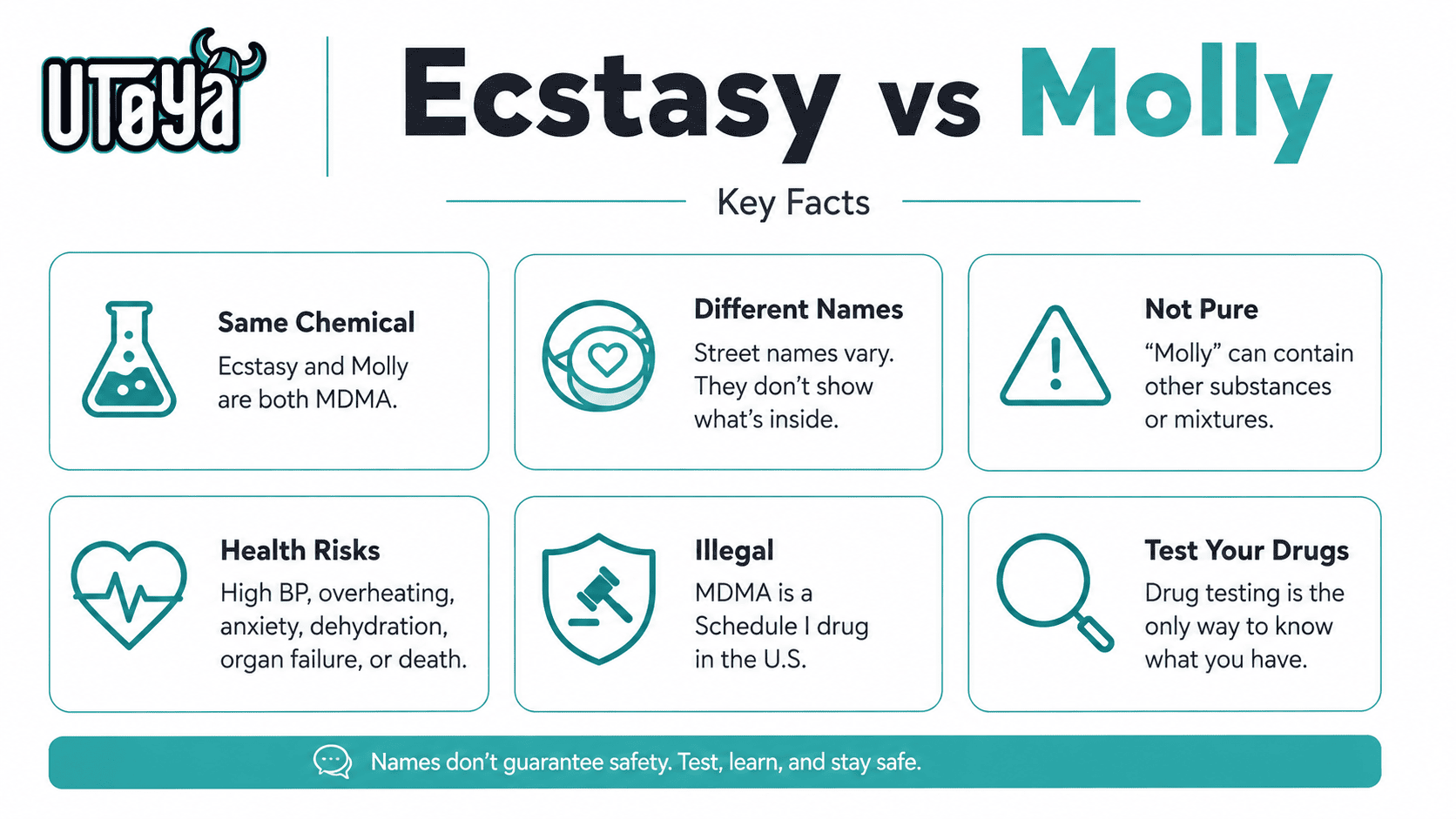
- MDMA is the chemical name. It stands for 3,4-methylenedioxymethamphetamine.
- Molly is a street name associated with MDMA. It is not a separate chemical substance.
- Ecstasy is another common name for MDMA. Street terminology often differs by form and setting, but the labels do not reliably identify a product’s contents.
- “Molly” does not mean pure MDMA. Illicit products sold under that name can contain other substances or mixtures.
- MDMA can cause serious health effects. Risks include increased blood pressure, overheating, anxiety, dehydration, and, in severe cases, organ failure or death.
- MDMA remains a Schedule I controlled substance under current U.S. federal law.
Shop Now
What Is MDMA?
MDMA is a synthetic psychoactive drug.
Its full chemical name is 3,4-methylenedioxymethamphetamine. NIDA describes it as having effects similar to stimulants while also producing changes in perception that lead some researchers to classify it as a psychedelic.
MDMA affects several chemical signaling systems in the brain, including serotonin, dopamine, and norepinephrine. Those systems are involved in functions such as mood, energy, sleep, and behavior.
People may associate MDMA with increased energy, alertness, emotional warmth, or feelings of closeness. Those effects are also accompanied by real health risks, which can become serious depending on the substance involved, its contents, the person’s health, and the circumstances surrounding its use.
So What Exactly Is Molly?
“Molly” is informal street terminology rather than the scientific name of another drug.
That distinction is worth making because the word sometimes carries an implication that the product is somehow different from ordinary MDMA.
It isn’t a different chemical category.
If a substance genuinely contains only MDMA, then calling it Molly rather than MDMA does not change what the active drug is. NIDA explicitly refers to MDMA as also being called Molly and Ecstasy.
The problem is that street names are marketing terms, not laboratory results.
A seller can call a powder or capsule Molly. That does not verify what is inside it.
Is Molly Supposed to Be “Pure” MDMA?
This is probably where most of the confusion begins.
Molly has often been marketed or talked about as though it means a purer form of MDMA, frequently associated with powder, crystals, or capsules rather than a pressed tablet.
But the name itself proves nothing about purity.
NIDA reports that chemical analyses of products sold as MDMA have identified substances including ketamine, amphetamine, synthetic cathinones, MDA, and methamphetamine.
DEA likewise reports that illicit products sold as ecstasy may contain MDMA mixed with other drugs—or may contain no MDMA at all.
That is the more useful distinction:
MDMA describes a specific chemical. Molly describes what an illicit product is being called.
Those two things do not always match.
Molly vs. MDMA vs. Ecstasy
The terminology is easier to understand when separated from the street marketing.
| Term | What It Means |
| MDMA | The abbreviation for the chemical 3,4-methylenedioxymethamphetamine |
| Molly | A street name used for products represented as MDMA |
| Ecstasy | Another common street name associated with MDMA, often linked with tablets |
| Actual contents | Cannot be established from a street name, color, logo, powder, capsule, or appearance alone |
NIDA and MedlinePlus both identify Molly and Ecstasy as common names for MDMA.
The names may be used differently in everyday conversation, but none of them gives a reliable guarantee about what an illicit product actually contains.
Why Does the Difference Matter?
Because believing that “Molly” automatically means pure MDMA can create a false sense of certainty.
If someone believes they know exactly what they have taken, they may interpret unexpected symptoms as normal even when another substance is involved.
Adulteration also makes effects less predictable. A person expecting MDMA could instead be exposed to another stimulant, synthetic cathinone, or a combination of substances with different risks.
Poison Control similarly warns that products sold as Molly can contain unexpected substances and should not be assumed to be pure based on the label.
That is why the wording matters. Saying “Molly is pure MDMA” is inaccurate.
Saying “Molly is a street name for what is represented as MDMA” is much closer to reality.
Is Ecstasy the Same as Molly?
In terms of the drug the names are intended to refer to, yes. Both names are commonly associated with MDMA.
In everyday use, people sometimes use “ecstasy” for pressed tablets and “Molly” for powders or capsules.
That does not create two different drugs.
Nor does one form automatically make the contents safer or more predictable.
DEA notes that MDMA appears in tablets, capsules, powder, and liquid forms. It also reports that tablets sold as ecstasy may contain other substances.
Appearance is packaging.
It is not chemical identification.
What Are the Health Risks of MDMA?
MDMA affects both the brain and the body.
NIDA identifies potential effects including higher blood pressure, nausea, jaw clenching, vomiting, anxiety, panic attacks, sleep problems, and changes in mood. More serious reactions can include a dangerous rise in body temperature.
DEA likewise warns that MDMA can raise heart rate and blood pressure and may contribute to severe dehydration and hyperthermia. In severe cases, dangerously high body temperature can contribute to liver, kidney, cardiovascular, or brain complications.
The uncertainty surrounding street-drug contents can add another layer of risk because a person may not know which substance—or combination of substances—they were exposed to.
Can You Tell Whether Molly Is Real MDMA by Looking at It?
No reliable visual check can tell you that a street product contains MDMA.
Powder, crystals, capsules, tablet colors, logos, and packaging do not establish chemical composition. DEA documents MDMA being distributed in multiple physical forms and notes that products represented as ecstasy can contain other drugs.
That is another reason the word “Molly” should not be treated as a purity standard.
It is a name, not a certificate of contents.
Is MDMA Legal in the United States?
Under current federal law, MDMA remains a Schedule I controlled substance.
The DEA’s current drug-scheduling guidance lists 3,4-methylenedioxymethamphetamine, or ecstasy, among Schedule I substances. The federal regulation governing controlled-substance schedules likewise places MDMA within Schedule I.
That legal classification is separate from ongoing scientific research.
Researchers have studied MDMA in controlled clinical settings, including research involving post-traumatic stress disorder. NIDA distinguishes those supervised studies from illicit MDMA use.
Research into a substance does not mean that an illicit product sold as Molly is a medical treatment.
Is Molly the Same as THC or THCA?
No.
MDMA is a synthetic drug with its own chemical structure and pharmacological effects. THC and THCA belong to a separate category associated with cannabis and hemp.
Likewise, a mushroom product should not be assumed to have anything to do with MDMA simply because both may be described with words such as “psychoactive” or “psychedelic.”
The substance matters more than the marketing category.
This distinction is particularly useful when reading about products online, where terms such as hemp-derived, mushroom, psychedelic, Molly, ecstasy, and MDMA can sometimes appear close together despite referring to very different compounds.
What Should You Do If Someone Becomes Seriously Ill After Suspected Molly or MDMA?
Severe symptoms require medical attention.
Poison Control advises prompt emergency evaluation for someone experiencing significant medical distress after suspected ecstasy or MDMA exposure. Warning signs can include a dangerously high temperature, seizures, unconsciousness, severe agitation, or a very rapid heartbeat.
In the United States, call 911 for a medical emergency.
Poison Control is also available at 1-800-222-1222 for poisoning questions and immediate guidance.
Trying to identify a street drug by its name or appearance should not delay emergency care.
Shop Now
Why Accurate Drug Terminology Matters
Drug terminology gets messy quickly.
Street names change. Different names overlap. Marketing creates assumptions about purity that may not be supported by what is actually in a product.
That is why a simple question like “Is Molly the same as MDMA?” needs a slightly more careful answer than yes or no.
Molly is a street name for MDMA.
But something sold as Molly is not automatically verified MDMA.
That distinction helps separate the chemistry from the label—and, more importantly, avoids treating an unregulated street name as reliable information about purity or safety.
For Utoya readers researching cannabinoids, hemp-derived products, or mushroom products, the same basic rule is useful: know which compound you are actually reading about rather than assuming different psychoactive substances are interchangeable.
Call Utoya Organics today at 813-697-4747.
Frequently Asked Questions
Q: Is Molly literally MDMA?
A: Molly is a street name used for MDMA, so the terms are intended to refer to the same drug. The important exception is that an illicit product sold as Molly may contain other substances or may not match what it is claimed to contain.
Q: Is Molly purer than ecstasy?
A: The name Molly does not prove purity. NIDA and DEA both report that illicit products represented as MDMA or ecstasy can contain unexpected drugs or mixtures.
Q: Is ecstasy another name for MDMA?
A: Yes. Ecstasy and Molly are both common names associated with MDMA.
Q: Is MDMA a stimulant or a psychedelic?
A: MDMA has stimulant-like effects, while some researchers also classify it as a psychedelic because it can alter perception. NIDA describes both aspects of the drug.
Q: Can you identify MDMA from the color or shape of a pill?
A: No. Appearance alone does not reliably establish what an illicit tablet, capsule, crystal, or powder contains. DEA reports substantial variability in products represented as MDMA or ecstasy.
Q: Is MDMA being studied as a medicine?
A: Yes. MDMA has been investigated in supervised clinical research, including studies involving PTSD. Research settings use controlled protocols and should not be confused with illicit products sold as Molly or ecstasy.