“Legal ecstasy” sounds like the name of a specific substance. It is not.
The term is generally used as marketing language for products claimed to provide euphoria, altered perception, relaxation, stimulation, or other experiences while avoiding the controlled-substance status of MDMA. Depending on the product, the ingredients could involve hemp-derived cannabinoids, mushroom-derived compounds, herbs, or synthetic chemicals. Those substances do not necessarily work like MDMA, produce the same effects, or carry the same risks.
MDMA, by contrast, is a specific chemical: 3,4-methylenedioxymethamphetamine. The Drug Enforcement Administration describes MDMA—also called ecstasy or Molly—as a psychoactive drug with both stimulant and hallucinogenic effects. It remains a Schedule I controlled substance under federal law.
At Utoya, we think that distinction matters. Hemp-derived THC, THCA, Amanita products, and other psychoactive product categories should be understood according to their actual ingredients—not treated as chemically equivalent substitutes for MDMA.
Key Takeaways
- “Legal ecstasy” is a marketing phrase, not the name of a defined drug. Its ingredients, effects, safety profile, and legal status can vary considerably.
- MDMA is a specific synthetic substance associated with euphoria, stimulation, increased feelings of closeness, and altered sensory perception, but it also carries risks including hyperthermia, cardiovascular strain, dehydration, and potentially dangerous electrolyte disturbances.
- Hemp-derived THC products may be psychoactive, but their pharmacology and usual effects are different from MDMA. Cannabis can impair attention, memory, coordination, judgment, and reaction time.
- Amanita muscaria and muscimol should not be treated as MDMA-like substances. FDA says Amanita muscaria and certain constituents are not authorized as conventional food ingredients and may be harmful.
- “Legal” does not mean FDA-approved, risk-free, or legal everywhere. Federal hemp law is changing in late 2026, while states maintain their own restrictions.
Shop Now
What Does “Legal Ecstasy” Mean?
There is no official chemical, medical, or legal definition of “legal ecstasy.”
That is the first thing consumers should understand.
MDMA has a defined molecular identity. “Legal ecstasy” does not. Two products using similar marketing language could contain entirely different active ingredients and therefore produce very different effects.
The phrase has historically been applied to several categories, including synthetic substances marketed as alternatives to controlled drugs. More recently, people may also use broad terms such as “legal high” for psychoactive hemp or mushroom products.
That does not make those products versions of MDMA.
The comparison should therefore begin by asking:
What is actually in the product?
A cannabinoid product should be evaluated as a cannabinoid product. An Amanita product should be evaluated according to Amanita’s active constituents. A synthetic stimulant should be assessed according to that particular chemical.
The words on the front of the package cannot answer those questions by themselves.
What Is MDMA?
MDMA is a synthetic psychoactive chemical that produces stimulant effects alongside changes in mood, perception, and social feelings.
DEA describes commonly reported effects as euphoria, increased feelings of closeness and empathy, increased energy, changes in perception, increased heart rate and blood pressure, muscle tension, sweating, nausea, anxiety, and other physical or psychological effects.
Medical literature describes MDMA as increasing extracellular levels of serotonin, dopamine, and norepinephrine. Those neurotransmitter effects help explain both its psychoactive effects and some of its risks.
Street terms complicate the picture.
“Ecstasy” usually refers to pills sold as containing MDMA, while “Molly” commonly refers to powders or crystals marketed as MDMA. Neither street name guarantees that the material actually contains pure MDMA.
Illicitly obtained products may contain other psychoactive substances or contaminants.
That is different again from a product marketed as “legal ecstasy.”
Are the Claimed Effects of Legal Ecstasy and MDMA the Same?
No. Similar marketing claims do not mean the substances produce the same pharmacological effects.
A seller might describe a legal product with words such as “euphoric,” “social,” “uplifting,” or “relaxing.” Those descriptions are not evidence that the active ingredients affect the brain the way MDMA does.
This becomes clearer when comparing specific categories.
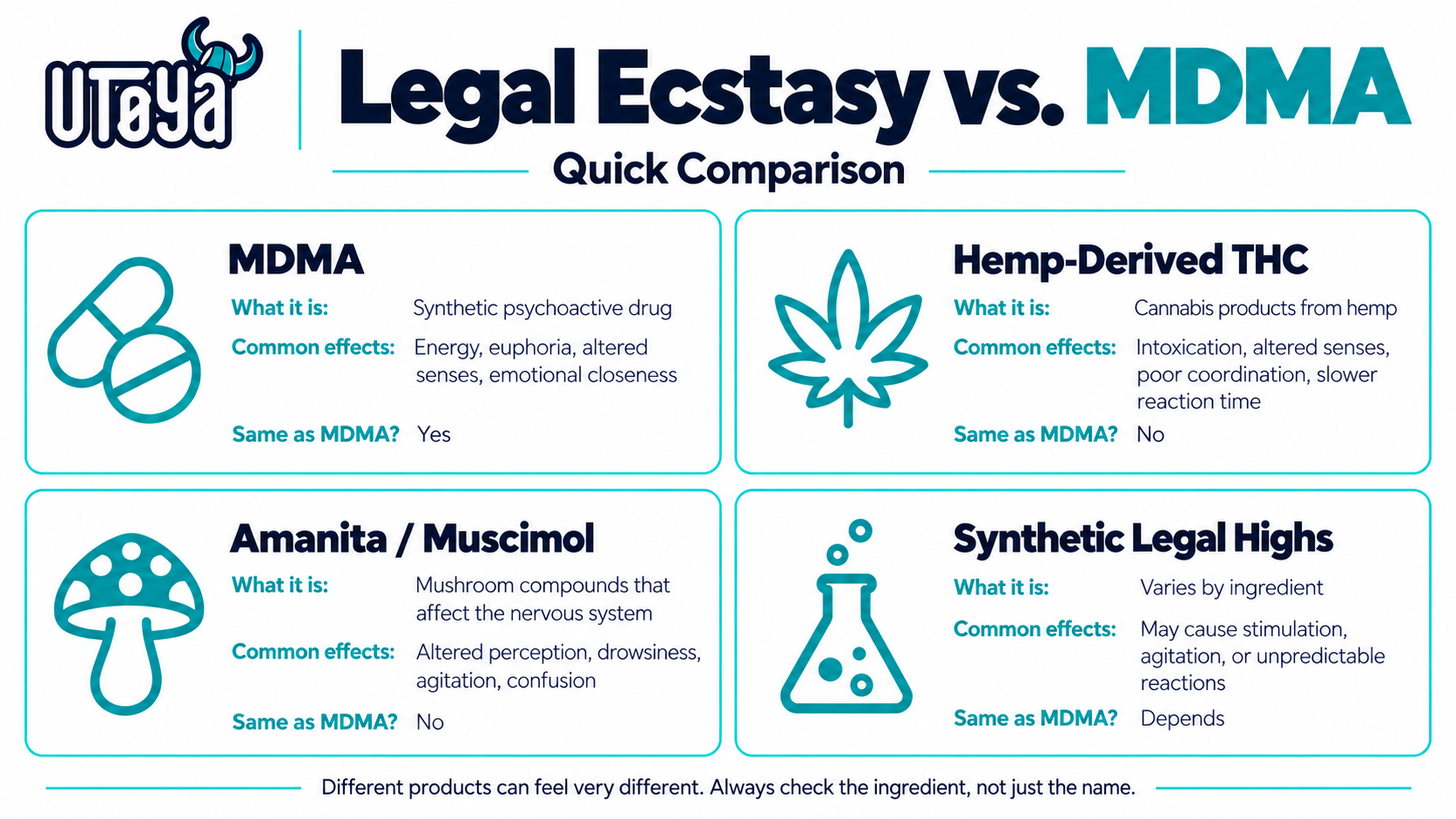
| Category | What It Is | Effects Commonly Associated With the Category | Same as MDMA? |
| MDMA | Specific synthetic psychoactive chemical | Stimulation, euphoria, altered perception, feelings of closeness or empathy | Yes—the reference substance |
| Hemp-derived THC products | Cannabis-derived cannabinoid products | Intoxication, altered perception, impaired coordination, changes in attention and reaction time | No |
| Amanita/muscimol products | Mushroom-derived compounds affecting the central nervous system | Can cause altered perception, drowsiness, agitation, delirium, or other neurological effects | No |
| Synthetic “legal highs” | Varies by chemical | Can range from stimulation to severe agitation or other unpredictable effects | Depends entirely on ingredient |
The useful comparison is therefore not:
“Does this feel like ecstasy?”
It is:
“What compound produces the effect, and what is known about that compound?”
How Are Hemp-Derived THC Effects Different From MDMA?
THC-containing products and MDMA affect the nervous system differently, even if both can produce changes in mood or perception.
Cannabis products primarily produce their psychoactive effects through the body’s cannabinoid system. MDMA’s characteristic effects are associated largely with major changes in monoamine neurotransmitters, including serotonin, norepinephrine, and dopamine.
CDC reports that recent cannabis use can affect:
- Thinking
- Attention
- Memory
- Coordination
- Movement
- Time perception
- Decision-making
- Reaction time
Cannabis can also increase heart rate and blood pressure immediately after use.
Those effects do not recreate MDMA’s pharmacology.
Calling a THC product “legal ecstasy” therefore tells you much less than knowing which cannabinoids it contains and reviewing its laboratory information.
Is THCA the Same Thing as MDMA?
No. THCA and MDMA are completely different chemicals.
THCA, or tetrahydrocannabinolic acid, is a cannabinoid occurring in cannabis. When sufficiently heated, THCA can convert to delta-9 THC.
MDMA is a synthetic substituted amphetamine.
They come from different chemical families, interact with the body differently, and are regulated under different legal frameworks.
The distinction is particularly important because the legal treatment of THCA and hemp is changing.
USDA hemp testing already considers the potential conversion of THCA into delta-9 THC when evaluating hemp crops and calculates total available THC using both compounds.
Federal legislation enacted in 2025 also changes the statutory definition of hemp to consider total tetrahydrocannabinols, including THCA, and creates additional limits for hemp-derived cannabinoid products. Congress subsequently limited the application of much of those amendments until December 11, 2026.
So a statement that a THCA product is simply “legal because it is hemp” is increasingly incomplete.
What About Amanita Products Marketed as Legal Psychedelics?
Amanita muscaria products are not MDMA substitutes, and the word “legal” should not be interpreted as proof of safety or FDA authorization.
Amanita muscaria contains compounds including muscimol and ibotenic acid. Their pharmacology differs substantially from both MDMA and THC.
FDA reviewed Amanita muscaria, its extracts, muscimol, ibotenic acid, and muscarine and concluded that they do not meet the Generally Recognized as Safe standard for use in conventional food. FDA states that foods containing these ingredients can be considered adulterated under federal food law and recommends that consumers avoid foods containing them.
FDA has reported adverse events associated with such products, including:
- Drowsiness and central nervous system depression
- Agitation
- Seizures
- Hallucinations
- Cardiovascular effects
- Hospitalization
Severe neurological effects have also been reported with large exposures.
That does not mean Amanita and MDMA have the same danger profile.
It means they are different psychoactive substances with different risks, and neither should be evaluated from a marketing nickname alone.
What Are the Main Health Risks of MDMA?
MDMA can cause serious acute medical complications, particularly involving body temperature, cardiovascular stress, and fluid or electrolyte balance.
DEA states that MDMA can increase heart rate, blood pressure, motor activity, sweating, muscle tension, and body temperature. At high exposures, impaired temperature regulation can result in severe hyperthermia and potentially contribute to kidney, liver, cardiovascular, or neurological complications.
A 2025 clinical review also identifies possible complications including:
- Hyperthermia
- Dehydration
- Hypertension and rapid heart rate
- Cardiac rhythm problems
- Serotonin syndrome
- Hyponatremia, or dangerously low blood sodium
- Seizures
- Acute kidney or liver injury in severe cases
Illicitly obtained MDMA creates another variable because products sold as ecstasy or Molly may contain different psychoactive chemicals than the buyer expects.
Can Drinking Too Much Water Be Dangerous With MDMA?
Yes. MDMA-related medical risk is more complicated than simply “avoid dehydration.”
Medical literature documents hyponatremia associated with MDMA. Excessive water intake combined with MDMA-related changes in vasopressin and sodium balance can cause blood sodium to fall dangerously low and, in severe cases, contribute to cerebral edema.
This is one reason health advice around an illicit drug should not be reduced to a simple social-media rule.
Are “Legal Ecstasy” Products Safer Because They Are Legal?
No. Legal status and medical safety are separate questions.
A substance can avoid scheduling under the Controlled Substances Act and still:
- Cause intoxication
- Interact with medications
- Produce adverse reactions
- Contain inconsistent concentrations
- Be prohibited as a food ingredient
- Violate state law
- Become illegal because of a change in its formulation or the law
FDA provides a good example with delta-8 THC.
The agency states that delta-8 THC products have psychoactive and intoxicating effects and have not been evaluated or approved by FDA for safe use in any context. FDA has also raised concerns about variability in formulation, adverse-event reports, and contaminants created during some manufacturing processes.
So “federally unscheduled,” “hemp-derived,” and “FDA-approved” are not synonyms.
Is MDMA Legal in the United States?
MDMA remains a Schedule I controlled substance under U.S. federal law.
DEA currently lists 3,4-methylenedioxymethamphetamine, or MDMA/ecstasy, among Schedule I substances.
MDMA has been investigated in clinical research, including as part of psychotherapy studies for post-traumatic stress disorder. Clinical research, however, does not make recreational MDMA possession lawful.
An FDA advisory process considered an MDMA-based application for PTSD in 2024, but MDMA’s federal controlled-substance status remains Schedule I today.
Is “Legal Ecstasy” Actually Legal?
There is no single answer because there is no single substance called legal ecstasy.
Legality depends on:
- The active ingredient
- Its concentration
- How the compound was produced
- Product format
- Federal controlled-substance law
- Federal food and drug law
- The state where it is sold or possessed
- Changes in law over time
Synthetic products create additional complications.
DEA notes that a substance does not necessarily have to be individually listed by name to create federal controlled-substance liability. Under federal analogue provisions, certain substances substantially similar to Schedule I or II controlled substances and intended for human consumption may be treated as Schedule I substances.
Calling something “legal” on a package does not settle the question.
What Is the Current Legal Situation for Hemp-Derived THC and THCA?
As of October 11, 2026, U.S. hemp law is in the middle of a significant transition.
The 2018 federal framework generally excluded qualifying hemp from the Controlled Substances Act based on a delta-9 THC threshold of no more than 0.3% on a dry-weight basis.
Congress enacted Public Law 119-37 in November 2025 to replace that definition with a stricter one that considers total THC, including THCA, and adds restrictions affecting consumable hemp-derived cannabinoid products.
Congress then enacted Public Law 119-103 on September 2, 2026. That law limits which portions of the new hemp amendments apply before December 11, 2026.
The practical takeaway is simple:
The legality of an intoxicating hemp product should be checked using current law and the product’s actual composition—not an article written several years ago.
State law adds another layer.
What Does Florida Law Require for Hemp Products?
Utoya is based in Florida, so Florida rules are particularly relevant to our discussion.
Florida’s 2026 hemp statute defines qualifying hemp and regulates hemp extracts sold within the state. Among other requirements, hemp extract sold in Florida must have an independent certificate of analysis showing compliance with applicable THC limits and contaminant standards. Required packaging information includes access to the COA, batch information, an expiration date, and cannabinoid content.
Florida law also restricts sales of certain inhalable hemp products to people under 21.
These rules illustrate why “legal” should always be followed by another question:
Legal where, in what form, and on what date?
Legal Ecstasy vs. MDMA: Side-by-Side Comparison
| Factor | “Legal Ecstasy” | MDMA |
| Defined substance? | No. Marketing term covering potentially different ingredients | Yes. Specific chemical compound |
| Predictable pharmacology? | Depends entirely on ingredients | Better characterized scientifically, although illicit products may be adulterated |
| Claimed effects | Varies: may be marketed for euphoria, relaxation, stimulation, or altered perception | Euphoria, stimulation, emotional closeness, altered sensory perception |
| Main safety issue | Ingredient uncertainty plus risks specific to the active compound | Hyperthermia, cardiovascular stress, dehydration/hyponatremia, serotonin-related complications |
| Federally Schedule I? | Depends on ingredient | Yes |
| FDA-approved simply because legal? | No | No approved recreational use |
| State laws matter? | Yes, substantially | Possession remains federally controlled; state issues may also apply |
| Equivalent to the other? | No | No |
How Can Consumers Evaluate a Product Marketed as a “Legal High”?
Start with ingredients and independent testing rather than the promised experience.
A useful label or COA can help answer questions such as:
- Which active cannabinoids or other compounds are present?
- How much of each is reported?
- Does the COA match the product and batch?
- Was contaminant testing performed?
- Does the product comply with the law where it will be sold or possessed?
A COA does not prove that a psychoactive product is risk-free or FDA-approved.
It does, however, provide more useful information than a name such as “ecstasy alternative,” “legal high,” or “party blend.”
At Utoya, our current product categories include hemp-derived cannabinoid and mushroom products. We believe those categories should be identified by what they actually contain rather than described as though they are chemically interchangeable with Molly or MDMA.
Does “Natural” Mean Safer Than MDMA?
No. Natural origin does not establish safety.
Cannabis cannabinoids are plant-derived. Amanita muscaria is a mushroom. Both can produce physiologically meaningful effects.
FDA’s conclusions regarding Amanita are a particularly clear example: a naturally occurring mushroom can still contain compounds that regulators determine do not meet food-safety standards.
Likewise, hemp-derived THC can still be psychoactive and impair memory, coordination, reaction time, and judgment.
Safety depends on the substance, amount, formulation, individual, interactions, and other circumstances—not whether the ingredient came from a plant, mushroom, or laboratory.
What If a Product’s Ingredient List Is Vague?
Do not assume the marketing name tells you what is inside.
This matters especially for psychoactive products.
FDA’s investigation of Diamond Shruumz products illustrated how complicated the market can become. Laboratory analyses identified different substances across tested samples, including muscimol, psilocin, acetylpsilocin, pregabalin, and kavalactones. Not every product contained the same substances.
That investigation was specific to those products and should not be generalized to unrelated brands.
It does demonstrate the broader point: ingredient transparency matters when a product can alter consciousness or perception.
Shop Now
The Ingredient Matters More Than the Nickname
The biggest mistake in a “legal ecstasy vs. MDMA” comparison is assuming there are two clearly defined drugs sitting on opposite sides of the law.
There are not.
MDMA is a specific Schedule I substance with a well-studied pharmacological profile and serious known risks. “Legal ecstasy” can mean almost anything until the ingredients are identified.
A hemp-derived THC product is not MDMA. THCA is not MDMA. Amanita is not MDMA. And an unfamiliar synthetic compound should not be presumed safe or lawful simply because its packaging uses the word “legal.”
At Utoya, we encourage people researching hemp-derived THC, THCA, or mushroom products to focus on ingredient transparency, current legal requirements, and available laboratory information rather than trying to judge a product from a nickname associated with another drug.
Federal and state laws governing psychoactive hemp products are changing quickly in 2026, so legal status should always be verified for the specific product and jurisdiction. Call Utoya Organics today at 813-697-4747.
Frequently Asked Questions
Q: Is legal ecstasy the same as MDMA?
A: No. MDMA is a specific synthetic chemical. “Legal ecstasy” is an informal marketing term and can refer to products containing completely different substances. Similar claims about euphoria or mood do not make the chemistry equivalent.
Q: Is MDMA the same thing as ecstasy?
A: MDMA is the chemical commonly associated with ecstasy. Street ecstasy usually refers to tablets sold as containing MDMA, but illicit tablets can contain other substances or inconsistent amounts.
Q: Is hemp-derived THC legal?
A: The answer depends on the product, jurisdiction, and date. Federal hemp law is currently changing, and states can impose requirements or prohibitions beyond federal law. As of October 11, 2026, businesses and consumers should verify current federal and state rules rather than relying solely on the 2018 Farm Bill.
Q: Is THCA a legal version of MDMA?
A: No. THCA and MDMA are unrelated substances. THCA is a cannabinoid precursor to delta-9 THC, while MDMA is a synthetic psychoactive drug. Their effects, chemistry, and legal treatment are different.
Q: Is Amanita a legal form of ecstasy?
A: No. Amanita muscaria is a mushroom with psychoactive constituents, not a form of MDMA. FDA says Amanita muscaria, muscimol, ibotenic acid, and muscarine are not authorized for use as ingredients in conventional food and may be harmful.
Q: Does legal mean a psychoactive product is safe?
A: No. Legal status tells you whether a particular law permits or restricts something under specific circumstances. It does not demonstrate medical safety, purity, FDA approval, or freedom from impairment.
Q: Are hemp-derived THC products FDA-approved?
A: FDA has not approved delta-8 THC products for safe use and has raised concerns about adverse events, manufacturing contaminants, and inconsistent formulations. Different cannabinoid products can raise different regulatory questions.