Ecstasy is a common name for MDMA (3,4-methylenedioxymethamphetamine), a synthetic psychoactive drug with stimulant effects and some psychedelic properties. It can increase energy, emotional openness, feelings of closeness, and sensitivity to sights, sounds, and touch. It can also cause serious health problems, including dangerously high body temperature, cardiovascular stress, anxiety, and other complications.
Ecstasy is commonly associated with clubs, festivals, concerts, and parties, which is why it is often described as a “club drug.” However, the setting does not determine what is actually in a tablet or powder sold as ecstasy. Illicit MDMA products can contain unexpected substances, making their effects less predictable.
Key Takeaways
- Ecstasy is a common name for MDMA, a synthetic psychoactive drug with stimulant effects and some psychedelic properties.
- Ecstasy and Molly usually refer to MDMA, but illicit pills, powders, and crystals may contain other substances.
- MDMA affects serotonin, dopamine, and norepinephrine, which can influence mood, energy, perception, and feelings of social connection.
- Serious risks include overheating, cardiovascular strain, anxiety, confusion, and unpredictable reactions, especially when other substances are involved.
- MDMA is different from THC, THCA, and mushroom-derived products and is currently a Schedule I controlled substance under U.S. federal law.
Shop Now
What Is MDMA?
MDMA is short for 3,4-methylenedioxymethamphetamine. It is made in a laboratory rather than occurring naturally in a plant or mushroom.
The National Institute on Drug Abuse (NIDA) describes MDMA as a synthetic drug with effects similar to stimulants, while noting that some researchers also classify it as psychedelic because it can mildly alter visual and time perception.
The Drug Enforcement Administration (DEA) similarly describes ecstasy/MDMA as having both stimulant and hallucinogenic effects.
In the United States, MDMA is currently classified as a Schedule I controlled substance under federal law.
Are Ecstasy and Molly the Same Thing?
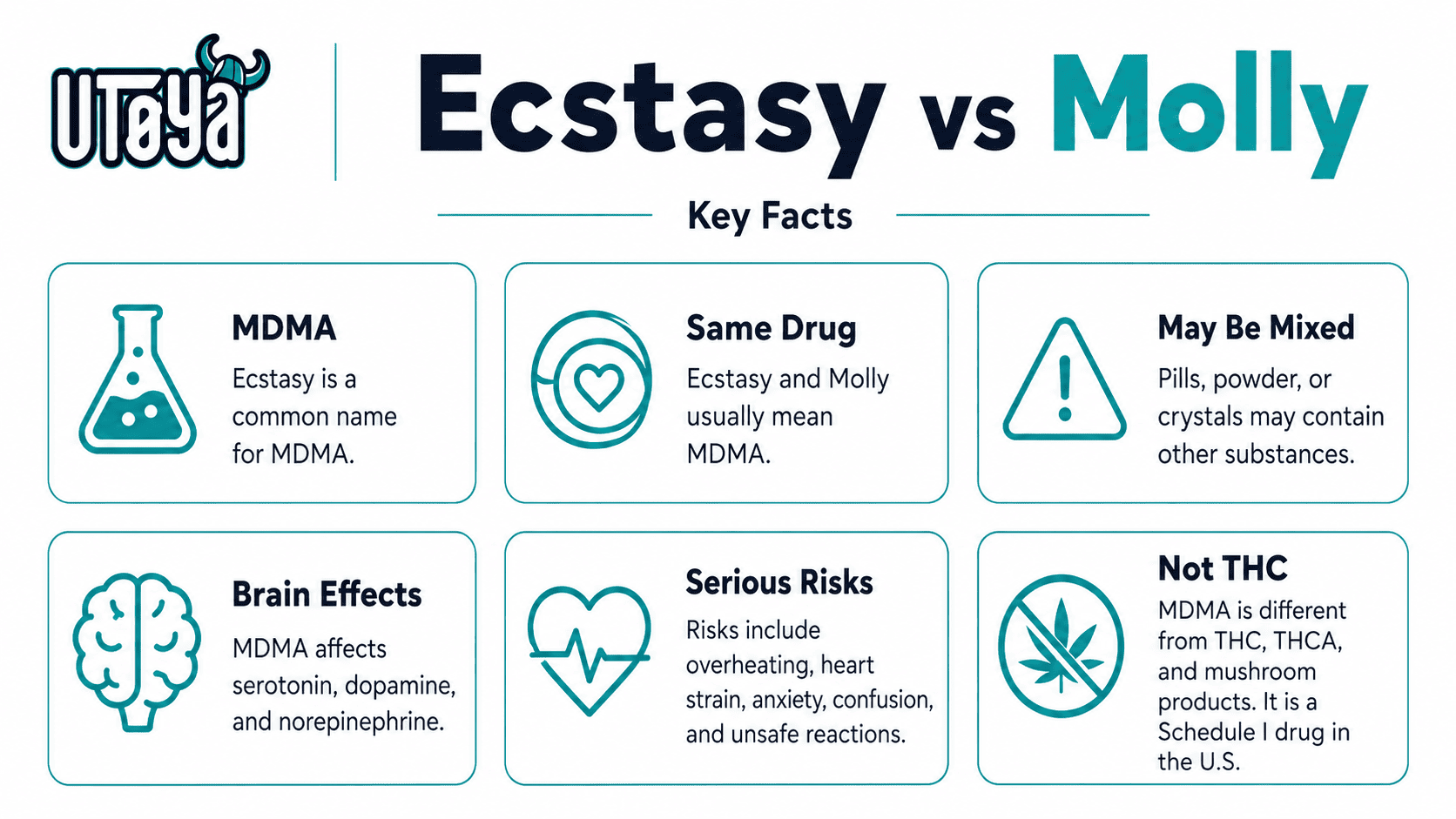
Ecstasy and Molly usually refer to MDMA, but the names do not tell you what a street product actually contains.
“Ecstasy” is often associated with pressed tablets, sometimes made in different colors or stamped with logos. “Molly” is commonly used for powder or crystalline products and is sometimes marketed as a purer form of MDMA.
That claim should not be taken as a guarantee.
NIDA reports that laboratory analyses of substances sold as MDMA have identified other drugs, including ketamine, amphetamine, methamphetamine, MDA, and synthetic cathinones. In other words, a product labeled “Molly” can still be adulterated or contain something unexpected.
How Does Ecstasy Affect the Brain?
MDMA affects several chemical messengers in the brain, particularly serotonin, dopamine, and norepinephrine.
Serotonin is involved in processes such as mood, sleep, appetite, and pain. Dopamine plays an important role in reward and motivation, while norepinephrine influences functions including alertness and cardiovascular activity.
MDMA can increase the release of these neurotransmitters and affect how they are taken back up by nerve cells. These changes help explain why people may experience increased energy, altered perception, emotional warmth, and a stronger sense of connection with others.
However, those effects can occur alongside anxiety, confusion, physical strain, or other unwanted reactions.
What Does Ecstasy Feel Like?
Reported effects vary considerably depending on the individual, the substance actually taken, other drugs or medications involved, and the surrounding environment.
People may report euphoria, increased alertness, emotional openness, greater sociability, heightened sensitivity to touch or sound, and changes in their perception of time.
Physical effects can include a faster heart rate, higher blood pressure, sweating, nausea, muscle tension, tremors, blurred vision, and jaw or teeth clenching. Anxiety, paranoia, confusion, and panic can also occur.
The experience is therefore not reliably predictable simply because something is sold under the name “ecstasy” or “Molly.”
How Long Do the Effects of Ecstasy Last?
MDMA’s noticeable effects generally last for several hours, although the exact experience varies from person to person.
NIDA reports that effects may begin within roughly 45 minutes after a single dose and typically persist for a few hours. Factors such as the substance’s composition, individual metabolism, use of other drugs or medications, and physical environment can affect the experience.
Some people also report fatigue, disrupted sleep, low mood, anxiety, or difficulty concentrating after the main effects have worn off.
This is often called a comedown. Describing it only as “serotonin depletion,” however, oversimplifies what can be a more complicated combination of drug effects, sleep disruption, physical exertion, environment, and individual biology.
What Are the Main Risks of Ecstasy?
One of the most serious risks associated with MDMA is a dangerous rise in body temperature.
MDMA can interfere with the body’s ability to regulate temperature. This becomes particularly concerning during prolonged physical activity or in hot, crowded environments. Severe hyperthermia can contribute to liver, kidney, cardiovascular, and neurological complications and can be fatal.
Other potential problems include increased blood pressure, rapid heart rate, nausea, vomiting, anxiety, panic attacks, sleep problems, and changes in mood or cognition. NIDA also notes that the risks can change when MDMA is combined with alcohol, prescription medications, or other substances.
Another major concern is uncertainty about what an illicit product contains. A tablet’s color, logo, appearance, name, or price does not establish its chemical contents.
Can Ecstasy Be Addictive?
MDMA has the potential for problematic use, although research into its addictive properties is more nuanced than it is for some other drugs.
NIDA reports that some people who use MDMA experience symptoms associated with substance use disorder, including craving, tolerance, continued use despite negative consequences, and withdrawal-related effects. Researchers continue to study the extent of MDMA’s addictive potential.
That means describing ecstasy as completely “non-addictive” would be misleading.
Can MDMA Be Used as Medicine?
MDMA has been studied in controlled clinical research, including research related to post-traumatic stress disorder and other mental health conditions. That research is very different from taking an illicit product sold as ecstasy or Molly.
Clinical research uses controlled manufacturing, screening, medical supervision, defined protocols, and monitoring. Street products do not provide those safeguards.
The FDA continues to develop guidance for clinical investigations involving psychedelic drugs, including research into potential psychiatric treatments.
Research into MDMA’s therapeutic potential should therefore not be interpreted as evidence that recreational ecstasy is medically safe.
Is Ecstasy the Same as THC, THCA, or Mushrooms?
No. MDMA, THC, THCA, and mushroom-derived compounds are different substances with different pharmacology, effects, risks, and legal considerations.
MDMA is a synthetic psychoactive substance. THC is a cannabinoid associated with cannabis, while THCA is a cannabinoid precursor that can convert to THC under certain conditions. Amanita mushroom products are another separate category.
This distinction is especially relevant for Utoya customers. Utoya’s hemp-derived THC, THCA, and Amanita product categories should not be confused with ecstasy or MDMA.
Laws governing cannabinoids and mushroom products can also vary by product, jurisdiction, and regulatory interpretation, so availability does not establish legality everywhere.
What Should You Do During a Suspected Ecstasy Emergency?
A suspected MDMA overdose or severe reaction can require immediate medical care.
Warning signs can include dangerously high body temperature, seizures, collapse, serious confusion or agitation, difficulty breathing, loss of consciousness, or an inability to wake the person.
If someone collapses, has a seizure, has trouble breathing, or cannot be awakened, call 911 immediately in the United States. Poison Control can also be reached at 1-800-222-1222 for poisoning-related guidance.
Do not assume a person experiencing severe symptoms simply needs to “sleep it off.” Serious MDMA toxicity can progress quickly.
Shop Now
The Bottom Line
So, what is ecstasy? Ecstasy is the common name for MDMA, a synthetic psychoactive drug that can increase energy, emotional openness, and sensory intensity while also carrying potentially serious physical and psychological risks.
Perhaps the most important point is that the name on an illicit product does not guarantee what is inside it. Ecstasy and Molly can be adulterated, and severe reactions—including dangerous overheating—can require emergency medical treatment.
Utoya specializes in hemp-derived THC, THCA, and Amanita product categories rather than MDMA. Consumers should treat each substance category separately and understand its effects, risks, and applicable laws before making decisions.
About Utoya and Valhalla Rewards: Eligible Utoya purchases can earn Valhalla Rewards, with 1 point earned per $1 spent and 10 points redeemable for $1 off. Points can be accumulated for larger discounts, and eligible friend referrals earn $5 each. Product availability and applicable rules may vary by location. Call Utoya Organics today at 813-697-4747.
Frequently Asked Questions About Ecstasy
Q: What is ecstasy made from?
A: Ecstasy generally refers to the synthetic drug MDMA. Because illicit tablets and powders are not subject to reliable manufacturing standards, products sold as ecstasy may also contain other substances.
Q: Is Molly different from ecstasy?
A: Both names commonly refer to MDMA. Molly is often marketed as powdered or crystalline MDMA, while ecstasy is often associated with tablets. Neither name guarantees a product’s purity or contents.
Q: Is ecstasy a stimulant or a hallucinogen?
A: MDMA has stimulant effects and can also alter perception. The DEA describes it as acting as both a stimulant and hallucinogen, while NIDA notes that some researchers classify it as a psychedelic drug.
Q: Is ecstasy legal in the United States?
A: Under current federal law, MDMA is a Schedule I controlled substance. State laws and specific legal circumstances can add other considerations, but recreational MDMA is not federally legal.
Q: Can you tell whether an ecstasy pill is pure by looking at it?
A: No. Color, shape, branding, logos, and whether a product is called “Molly” cannot establish its chemical contents. Laboratory analyses have found substances other than MDMA in products marketed as MDMA.
Q: Is ecstasy the same thing as magic mushrooms?
A: No. Ecstasy usually refers to MDMA, a synthetic substance. Mushroom products contain entirely different compounds and should not be treated as interchangeable with MDMA.