
What is Molly? Molly is a street name commonly associated with MDMA (3,4-methylenedioxymethamphetamine), a synthetic psychoactive drug with stimulant effects and some psychedelic or hallucinogenic properties. It can produce increased energy, euphoria, emotional warmth, and changes in sensory or time perception.
At Utoya, we think one distinction deserves to be made immediately: something sold as “Molly” cannot be assumed to contain pure MDMA. Illicit powders, capsules, and tablets may contain MDMA mixed with other substances—or may contain something different altogether. DEA has identified substances such as methamphetamine, ketamine, cocaine, synthetic cathinones, and caffeine in products sold as ecstasy or MDMA.
That uncertainty is one of the reasons Molly carries significant health risks beyond the effects of MDMA itself.
Key Takeaway
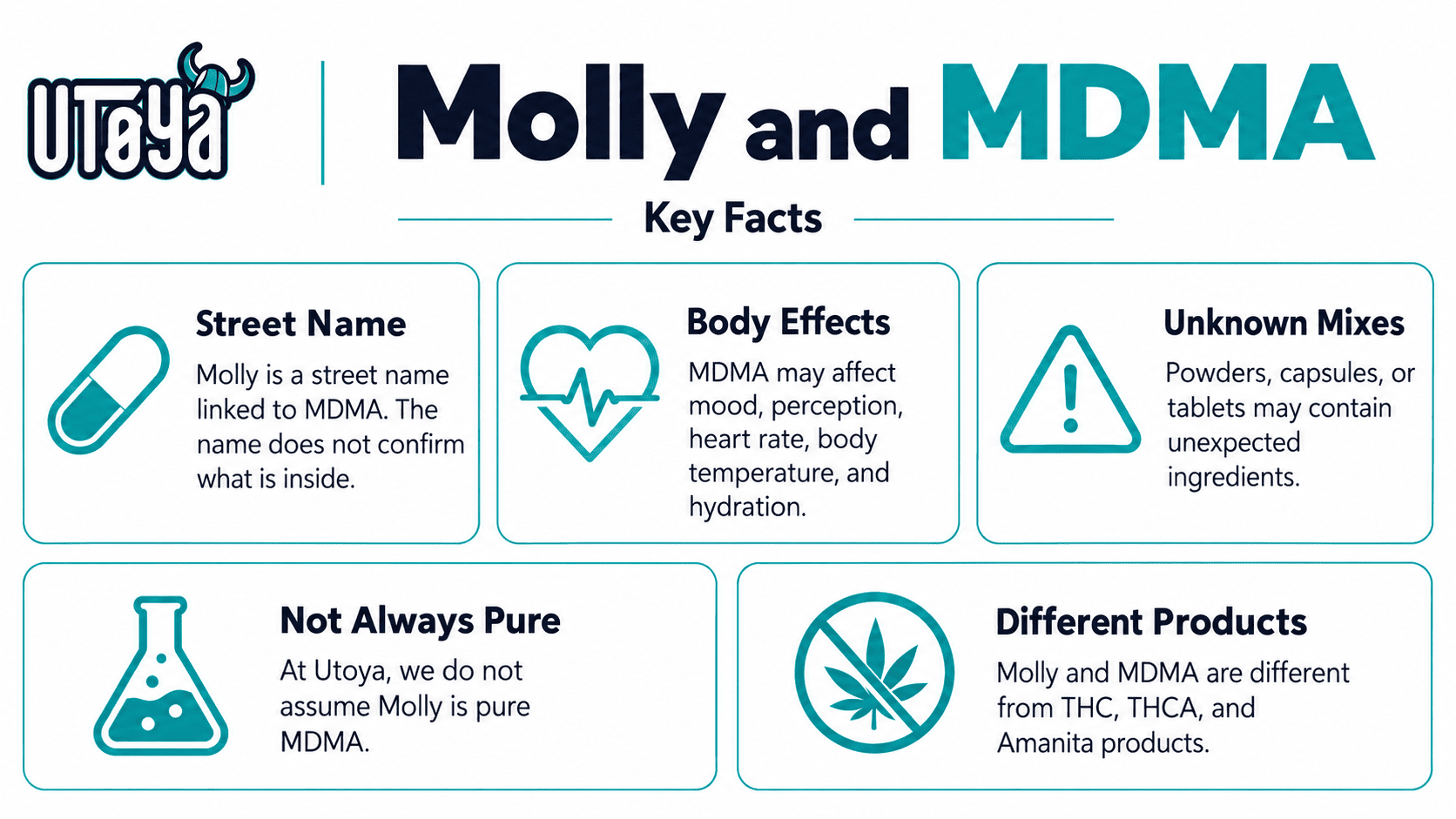
- Molly is a street name commonly associated with MDMA, but the name does not guarantee what a powder, capsule, or tablet actually contains.
- MDMA can affect mood, perception, heart rate, body temperature, and hydration.
- Unknown or unexpected ingredients can make the effects and health risks even less predictable.
- At Utoya, we believe Molly should not be assumed to be “pure MDMA.”
- Molly and MDMA should not be confused with hemp-derived THC, THCA, or Amanita products, which are different substances with different effects and risk profiles.
Shop Now
What Is Molly?
In practical terms, Molly usually refers to MDMA sold as a powder, crystal, or capsule, while the term “ecstasy” has traditionally been associated more closely with tablets. The distinction is mostly about street terminology and presentation, not a guarantee about what the substance contains.
NIDA describes MDMA as a lab-made drug with stimulant-like effects that can also mildly alter visual perception and the perception of time. DEA similarly classifies MDMA as having both stimulant and hallucinogenic effects.
| Term | What it usually refers to | Important distinction |
| Molly | Material sold as MDMA, often powder, crystals, or capsules | The name does not prove purity |
| Ecstasy | MDMA commonly sold in tablet form | Tablets may contain other drugs |
| MDMA | 3,4-methylenedioxymethamphetamine | The actual chemical substance |
We would not treat “Molly,” “ecstasy,” and verified MDMA as interchangeable from a safety standpoint because an illicit product’s contents may be unknown.
How Does Molly Affect the Brain?
MDMA changes signaling involving several neurotransmitters, particularly serotonin, dopamine, and norepinephrine. NIDA reports that MDMA increases the activity of all three, with especially strong effects on serotonin and norepinephrine.
Serotonin is involved in mood, sleep, appetite, pain, and other functions. The sharp changes in serotonin activity help explain why MDMA can produce feelings of emotional openness, well-being, and closeness to other people. Changes involving norepinephrine and dopamine contribute to stimulation, alertness, and cardiovascular effects.
The same mechanisms that produce the desired effects can also contribute to anxiety, sleep disruption, cardiovascular stress, overheating, and unpleasant psychological effects.
What Are the Short-Term Effects of Molly?
What is Molly? MDMA can affect both mental state and physical function. The exact response varies based on what the substance actually contains, individual health, other substances being used, and environmental conditions.
| Possible effects people seek | Possible unwanted effects |
| Euphoria | Anxiety or confusion |
| Increased energy and alertness | Increased heart rate |
| Emotional warmth or closeness | Increased blood pressure |
| Increased sensitivity to touch | Sweating or chills |
| Changes in sensory perception | Jaw clenching and muscle tension |
| Altered sense of time | Nausea, faintness, or blurred vision |
DEA reports that MDMA’s effects commonly begin within roughly 30 to 45 minutes and can last about four to six hours, although some unwanted psychological effects can persist considerably longer.
What Are the Biggest Risks of Molly?
Overheating and Hyperthermia
One of the most serious MDMA risks is hyperthermia, or a dangerous rise in body temperature. MDMA can interfere with temperature regulation, and the danger can increase in hot, crowded environments or during prolonged physical activity.
Severe hyperthermia can contribute to cardiovascular, kidney, or liver failure and can be fatal. CDC has also documented MDMA-associated medical emergencies involving hyperthermia, seizures, low blood sodium, muscle breakdown, and multiorgan failure.
Dehydration and Water Imbalance
Heavy sweating, high temperatures, and physical exertion can contribute to significant dehydration.
However, simply drinking excessive amounts of water is not a safe solution. MDMA intoxication has also been associated with hyponatremia, a dangerous condition in which blood sodium becomes too low. Severe electrolyte disturbances can affect the brain and become life-threatening.
Unknown or Unexpected Ingredients
What is Molly? The contents of Molly are not reliably established by its appearance, name, powder form, or capsule.
DEA reports that substances sold as ecstasy may contain no MDMA at all or may combine MDMA with methamphetamine, ketamine, cocaine, cathinones, caffeine, or related compounds such as MDA and PMA. This means a person may experience effects or toxicity they were not expecting.
This is also why describing Molly simply as “pure MDMA” is misleading.
Heart and Neurological Problems
MDMA can increase heart rate and blood pressure. Serious intoxication may involve seizures, very high body temperature, altered consciousness, severe agitation, or other medical complications.
Someone experiencing severe symptoms should not be expected to simply “sleep it off.”
What Is Molly Comedown?
Some people experience unpleasant physical or emotional effects after the main effects of MDMA fade. These can include fatigue, depressed mood, anxiety, difficulty sleeping, confusion, and problems concentrating.
NIDA explains that MDMA can cause a large release of serotonin and subsequent depletion, which may contribute to negative psychological effects for several days afterward.
How severe these effects become varies considerably. Frequency of use, other substances, sleep deprivation, overall health, and the actual contents of the product can all affect the experience.
Can Molly Cause Long-Term Effects?
Research has linked repeated or chronic MDMA use with concerns involving memory, learning, mood, sleep, and serotonin function. DEA notes that clinical studies suggest a possible increased risk of long-term memory and learning problems and that chronic MDMA exposure may affect the serotonin system.
There is an important limitation here. Research involving recreational MDMA users can be difficult to interpret because people may use multiple substances, and illicit products do not always contain what users believe they contain. For that reason, we would avoid presenting every reported long-term effect as inevitable.
What is clear is that repeated exposure is not risk-free, and some psychological or cognitive effects can continue after the immediate high has ended.
Can You Become Addicted to Molly?
MDMA’s addictive potential is less straightforward than that of some other drugs, but dependence and problematic use can occur.
NIDA reports that research has produced varying estimates of MDMA addiction or dependence. However, some people who regularly use MDMA report craving, tolerance, withdrawal symptoms, and continued use despite physical or psychological harm.
That makes repeated use worth taking seriously even when the substance is not being used every day.
Can Someone Overdose on Molly?
Yes. MDMA toxicity can become a medical emergency, particularly when body temperature rises sharply or the cardiovascular and nervous systems are severely affected.
DEA warns that high doses can disrupt temperature regulation and potentially contribute to organ failure, brain swelling, and death. Repeated use over a short period may also cause unexpectedly high concentrations of MDMA to accumulate in the body.
Emergency warning signs include seizures, collapse, inability to wake the person, trouble breathing, extremely high body temperature, severe confusion or delirium, and severe agitation. SAMHSA recommends immediate emergency care for these symptoms, while Poison Control advises calling 911 if a person collapses, has a seizure, has difficulty breathing, or cannot be awakened.
In the United States, Poison Control is also available at 1-800-222-1222 for suspected poison exposures.
Is Molly Legal in the United States?
Under current federal law, MDMA remains a Schedule I controlled substance in the United States. DEA’s current drug-scheduling information specifically lists 3,4-methylenedioxymethamphetamine, or ecstasy, among Schedule I substances.
Researchers have investigated MDMA in controlled therapeutic settings, including research related to PTSD. That research does not make recreational Molly legal or equivalent to pharmaceutical material administered within a clinical study.
Is Molly the Same as THC or Magic Mushrooms?
No. Molly/MDMA is chemically and pharmacologically different from THC, THCA, psilocybin-containing mushrooms, and Amanita products.
We think that distinction matters for anyone researching psychoactive substances. At Utoya, our product focus includes hemp-derived THC, THCA, and Amanita products. Those categories should not be confused with MDMA simply because some can alter mood, perception, or consciousness.
Different substances act through different biological pathways, have different risk profiles, and fall under different legal frameworks.
Shop Now
What to Know About Molly
The simplest answer to “What is Molly?” is that it is a street name generally associated with MDMA, a synthetic psychoactive substance that produces stimulant effects along with changes in mood and perception.
The more important answer is that the label does not tell someone exactly what is in an illicit powder, pill, or capsule. MDMA itself can cause overheating, cardiovascular stress, dehydration, electrolyte problems, seizures, psychological effects, and potentially life-threatening toxicity. Unknown ingredients add another layer of risk.
At Utoya, we believe clear substance information matters. If you’re researching hemp-derived THC, THCA, or Amanita products, we recommend treating them as their own categories rather than comparing their effects or safety directly with Molly or MDMA. Call Utoya Organics today at 813-697-4747.
Frequently Asked Questions About Molly
Q: Is Molly a stimulant or a psychedelic?
A: MDMA has characteristics of both. NIDA describes it as a synthetic substance with stimulant-like effects, while noting that some researchers classify it as psychedelic because it can alter visual and time perception. DEA describes MDMA as both a stimulant and hallucinogen.
Q: Is Molly always pure MDMA?
A: No. Calling a substance Molly says nothing reliable about its purity. DEA reports that products sold as MDMA or ecstasy may contain other drugs or may not contain MDMA at all.
Q: How long does Molly last?
A: DEA reports that effects commonly begin within 30 to 45 minutes and generally last around four to six hours. Psychological or physical aftereffects may persist beyond the main intoxication period.
Q: Is there a safe amount of Molly?
A: There is no way to establish a universally safe amount of an illicit substance sold as Molly, particularly because its identity, potency, and contaminants may be unknown. Serious reactions can also depend on individual health, other drugs or medications, and environmental conditions.