
The term is generally used for products marketed as alternatives to MDMA, but it is not a medical classification or a guarantee that a product is safe, FDA-approved, or lawful everywhere. Actual MDMA, commonly called ecstasy or Molly, remains a Schedule I controlled substance under U.S. federal law.
At Utoya, we believe the useful question is not simply, “Is this MDMA?” Before considering any psychoactive product, you need to know exactly what is in it, what is known about that ingredient, whether the product is lawful where you live, and what uncertainties remain.
That distinction matters even more with newer compounds such as 5-MAPB, which appears in products currently listed in our Legal Ecstasy category. Scientific information on these novel psychoactive substances is much more limited than it is for established medications.
Key Takeaways
- “Legal ecstasy” is a marketing term, not a guarantee that a product is legal or safe.
- Check the exact active compound rather than relying on words such as “Molly alternative” or “legal ecstasy.”
- Laws differ by substance and jurisdiction; 5-MAPB, for example, is expressly controlled in states including Florida and Texas.
- Human safety data for 5-MAPB remain limited, and documented intoxication has included cardiovascular, neurological, and temperature-related effects.
- Do not assume a legal ecstasy alternative will be invisible on a drug test. Screening methods and cross-reactivity vary, while targeted laboratory testing can identify compounds such as 5-MAPB.
- A certificate of analysis can help confirm what was tested, but it does not by itself prove that a psychoactive ingredient is safe or legal in your location.

1. What Does “Legal Ecstasy” Actually Mean?
“Legal ecstasy” usually describes a product intended to produce some effects consumers associate with ecstasy or Molly without being sold as MDMA itself.
That definition is broad. Different products may contain completely different substances, and those compounds can have different pharmacology, testing profiles, safety concerns, and legal status.
This is why we recommend starting with the ingredient list rather than the product nickname.
For example, our current Molly 2.0 product page identifies 5-MAPB, a benzofuran novel psychoactive substance, as its active material. Published scientific literature describes 5-MAPB as structurally and pharmacologically related to amphetamine-type substances and reports MDMA-like effects on monoamine systems.
A name such as “Molly 2.0” describes the type of experience a product is being positioned around. It should not be read as proof that the chemistry, risks, or legal treatment are the same as MDMA.
2. Do I Know the Exact Active Ingredient?
This should be the first safety question you ask.
Look for the specific chemical name of the active ingredient, not only a product name, blend name, or phrase such as “legal Molly.”
A useful product page should make it possible to answer:
- What is the active compound?
- Is the amount clearly disclosed?
- Does the packaging match the website description?
- Is there a current certificate of analysis?
- Does the laboratory report identify the same compound named on the product page?
- Are there other active ingredients in the formulation?
If those answers are unclear or contradictory, pause before using the product.
That matters because two products sold under the same broad “legal ecstasy” category can contain substances with very different effects.
3. Is It Actually Legal Where I Live?
You should never assume a product is legal simply because it is available online or marketed with the word “legal.”
Federal and state drug laws do not always treat a compound the same way.
MDMA is expressly listed by the DEA as a Schedule I substance. Federal law can also apply to certain unlisted substances through the Controlled Substance Analogue provisions when the statutory requirements are met. The DEA specifically warns that a chemical does not necessarily have to appear by name on the federal schedules to face controlled-substance treatment.
State laws can be more explicit.
For example, Florida’s current controlled-substance statute specifically names 5-MAPB, as does the Texas Controlled Substances Act.
That means a blanket statement that 5-MAPB is legal throughout the United States is not reliable.
Legal status should be checked by exact compound, state, and current date. Laws can change, and federal, state, and local rules may overlap.
This article provides general educational information, not legal advice.
4. How Much Do We Actually Know About Its Safety?
For newer psychoactive substances, the honest answer may be: not enough.
5-MAPB is a good example. It has appeared in scientific literature and toxicology reports, but it does not have the large body of controlled human safety research that exists for approved medications.
The World Health Organization has placed 5-MAPB on its substances-under-surveillance list and notes reported amphetamine-like effects that can include increased blood pressure and body temperature, wakefulness, physical activity, and rapid or irregular heartbeat.
A published case involving laboratory-confirmed 5-MAPB exposure reported symptoms including increased blood pressure, rapid heart rate, mild hyperthermia, agitation, hallucinations, tremor, convulsions, and reduced consciousness. The patient required hospital treatment.
That does not tell us exactly how every person will respond. It does show why phrases such as “legal alternative” should not be confused with “proven safe.”
5. Does a Lab Report Prove the Product Is Safe?
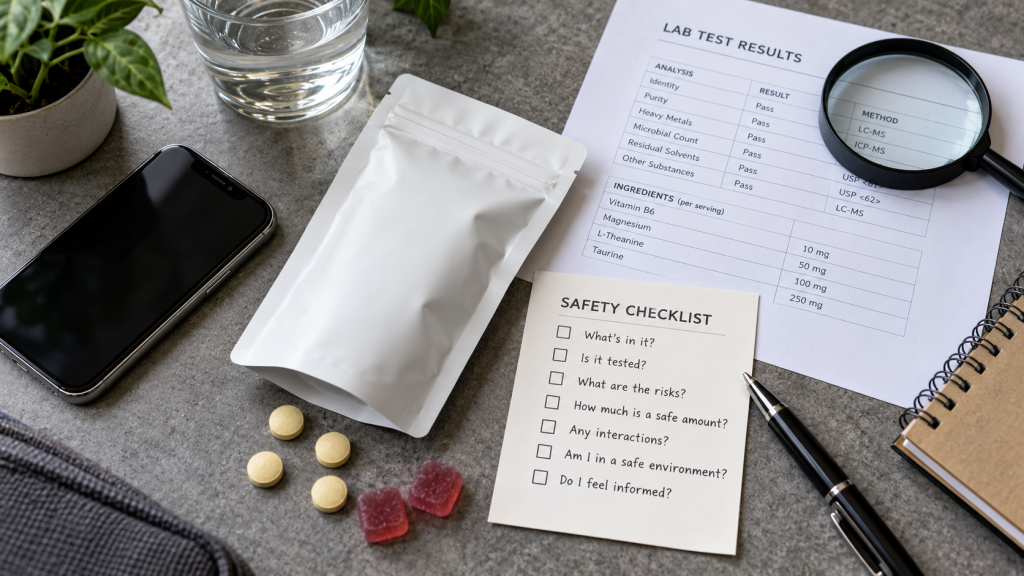
No. A certificate of analysis can answer useful quality-control questions, but it cannot establish that a psychoactive compound is risk-free.
Depending on what the laboratory actually tested, a COA may help confirm things such as ingredient identity, concentration, or contaminants.
Before relying on one, check:
- The product or batch name matches what you are buying.
- The report is recent enough to apply to the current batch.
- The testing laboratory is clearly identified.
- The active compound is specifically measured rather than inferred.
- The report explains which contaminants were tested.
- The document is complete rather than a cropped screenshot or marketing summary.
A lab result is evidence about the sample that was analyzed. It is not clinical evidence that the ingredient has been proven safe for you.
It also does not override controlled-substance law.
6. Could My Health or Medications Change the Risk?
Yes. Your health history and medications can materially change the risk of taking a psychoactive compound.
5-MAPB affects neurotransmitter systems involving serotonin, dopamine, and norepinephrine in experimental research. Those same systems are involved in cardiovascular function, body-temperature regulation, mood, alertness, and the effects of many prescription medicines.
Human interaction data for 5-MAPB are limited, so it is not possible to provide a reliable universal list of “safe combinations.”
Extra caution is appropriate if you:
- take prescription or over-the-counter medicines that affect the nervous system;
- have a heart, blood-pressure, seizure, liver, kidney, or psychiatric condition;
- are pregnant or breastfeeding;
- have previously reacted badly to stimulants or other psychoactive substances; or
- are considering combining several psychoactive products.
A doctor or pharmacist who knows your medications and medical history is in a much better position to assess individual risk.
7. Am I Assuming “More” Will Give Me a Better Experience?
With psychoactive substances, stronger exposure can also mean greater risk.
Newer substances are particularly difficult to predict because individual responses vary and the clinical evidence may be sparse. Product marketing cannot eliminate differences in body size, metabolism, health, medications, tolerance, or sensitivity.
We do not recommend treating another person’s experience as a dosing guide.
If a product label is unclear about its active ingredient or concentration, that uncertainty is itself a reason not to use it.
8. Could Legal Ecstasy Show Up on a Drug Test?
It can, depending on the compound and the testing method. You should not assume a product will produce a negative test simply because it does not contain MDMA.
MDMA itself is not detected reliably by every basic amphetamine immunoassay. Labcorp notes that standard amphetamine assays can have insufficient cross-reactivity with MDMA, which is why specific MDMA testing may use dedicated reagents.
That does not mean an MDMA alternative is “undetectable.”
Research involving benzofuran compounds, including 5-MAPB, has shown that these substances can interact with commercial amphetamine and ecstasy screening assays. In one published intoxication case, an initial urine immunoassay was positive for amphetamines, while subsequent GC-MS and UHPLC-MS/MS laboratory analysis identified 5-MAPB and other compounds.
Separate toxicology research has demonstrated that 5-MAPB and its metabolites can be identified in urine and plasma with appropriate analytical methods.
The practical answer is simple:
Do not rely on the words “legal,” “herbal,” “research chemical,” or “MDMA alternative” to predict a drug-test result.
Testing panels, specimen types, laboratory methods, cutoffs, metabolism, and the actual ingredients all matter.
9. What Warning Signs Mean I Should Get Medical Help?
Severe or rapidly worsening symptoms after taking any psychoactive substance deserve prompt medical attention.
Published 5-MAPB intoxication reports have included cardiovascular and neurological symptoms such as rapid heart rate, high blood pressure, overheating, confusion, hallucinations, agitation, convulsions, and reduced consciousness.
Seek emergency help for symptoms such as:
- seizure or loss of consciousness;
- severe confusion or extreme agitation;
- chest pain;
- difficulty breathing;
- very high body temperature;
- collapse;
- severe or irregular heartbeat; or
- symptoms that are rapidly becoming worse.
When getting medical care, tell clinicians what product was taken and show them the packaging or ingredient information if available. Accurate information can help them determine what they are treating.
10. Is “Legal” the Same Thing as Low Risk?
No.
Legal status and health risk answer two different questions.
A substance may be lawful in one jurisdiction and prohibited in another. A substance can also be unscheduled by name while still presenting significant health risks.
The reverse is true as well: drug scheduling does not provide a simple numerical measure of medical risk.
For legal ecstasy safety, the better decision process is:
Ingredient → evidence → jurisdiction → personal risk → product verification.
Knowing those five things gives you far more useful information than the word “legal” on its own.
Questions to Ask Before You Consider a Legal Ecstasy Product
Before making a decision, ask yourself:
- What is the exact active compound?
- Does the packaging clearly state how much is present?
- Can I verify that information against a current laboratory report?
- What human safety evidence exists for this specific ingredient?
- Is the compound legal in my state and under applicable federal law?
- Do I take medications or have health conditions that could increase risk?
- Am I relying on marketing language instead of chemical information?
- Could workplace, court, athletic, medical, or other drug testing be relevant?
- Do I know what symptoms would require medical attention?
- Am I comfortable with what is still unknown?
If you cannot confidently answer the first several questions, you do not have enough information to make an informed decision.
Make an Informed Decision Before You Buy or Use
Our view is simple: know what a psychoactive product actually contains before making a decision about it.
Read the complete product description. Check the available laboratory documentation. Verify the law where you live. If medications, medical conditions, or other substances are involved, speak with a qualified healthcare professional rather than relying on product marketing or someone else’s experience.
“Legal ecstasy” may be a convenient category name. Legal ecstasy safety depends on the actual compound, the evidence behind it, your individual circumstances, and the laws that apply to you. Call Utoya Organics today at 813-697-4747.
Frequently Asked Questions
Is legal ecstasy the same as MDMA?
No. MDMA is the substance commonly known as ecstasy or Molly and is federally classified as Schedule I in the United States. Products marketed as “legal ecstasy” may contain other compounds instead.
Does “legal ecstasy” mean FDA-approved?
No. Legal status, FDA approval, and safety are separate issues. A product being sold commercially does not establish that its psychoactive ingredient has been evaluated and approved by the FDA for recreational use.
Is 5-MAPB legal in every U.S. state?
No. Current statutes in states including Florida and Texas specifically list 5-MAPB as a controlled substance. Other jurisdictions may regulate it differently, and federal analogue law may also be relevant depending on the circumstances.
Can 5-MAPB show up on a drug test?
It can be detected with appropriate laboratory methods, and published research shows benzofurans can also cross-react with some amphetamine or ecstasy immunoassays. A negative or positive result cannot be predicted simply from the number of panels on a test.
Is a COA enough to know a product is safe?
No. A COA can provide useful information about what a laboratory found in a tested sample, but it cannot establish the overall medical safety of a psychoactive ingredient or determine whether the substance is lawful where you live.
Is 5-MAPB safer than MDMA?
There is not enough controlled human evidence to make that claim. Published case reports document serious 5-MAPB intoxication, while animal and laboratory research suggests significant effects on serotonin and other monoamine systems. It should not be described as a proven safer substitute for MDMA.