No, real ecstasy containing MDMA is not legal for ordinary recreational possession, sale, or use in the United States. MDMA remains a Schedule I controlled substance under federal law. Products marketed as “legal ecstasy,” however, may contain entirely different ingredients, so their legal status depends on the actual compound, federal law, and the law of the state where the product is sold or possessed.
That distinction matters. “Legal ecstasy” is a product or marketing description, not a legal classification created by Congress, the DEA, or state legislatures.
At Utoya, we believe shoppers should look past the name on the package and understand what is actually in a product. A compound that is different from MDMA is not automatically legal. Some substances are directly scheduled by individual states, while others may raise questions under the federal Controlled Substance Analogue Enforcement Act.
Key Takeaways
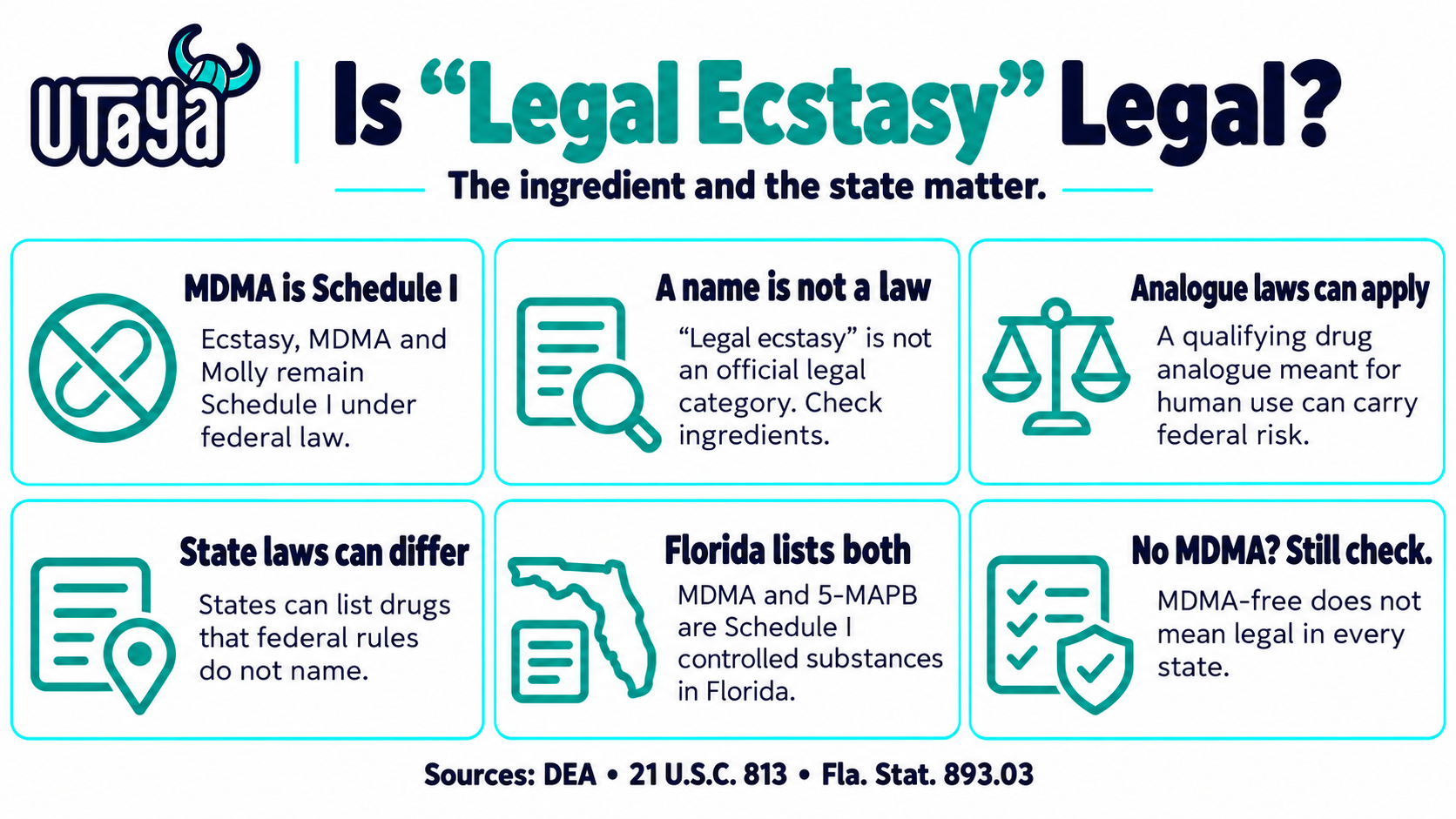
- Real ecstasy, also called MDMA or Molly, remains a Schedule I controlled substance under federal law.
- “Legal ecstasy” is not an official legal category; the exact ingredient determines which laws may apply.
- An unscheduled substance can still create federal legal risk if it qualifies as a controlled substance analogue intended for human consumption.
- States can separately schedule substances that federal regulations do not list by name.
- Florida expressly lists both MDMA and 5-MAPB as Schedule I controlled substances.
- Never assume a product is legal in every state simply because it does not contain MDMA.
What Does “Legal Ecstasy” Actually Mean?
“Legal ecstasy” generally refers to a product marketed as offering an experience associated with ecstasy or Molly without containing MDMA. The phrase itself does not establish that the product is lawful.
That is an important distinction because ecstasy, in the traditional drug-law sense, generally refers to MDMA, or 3,4-methylenedioxymethamphetamine. The DEA currently identifies MDMA as a Schedule I drug.
A product sold under a name such as “legal ecstasy,” “legal Molly,” or “Molly alternative” may contain another compound entirely. The legal question therefore changes from “Is ecstasy legal?” to “What is the active ingredient, and how is that specific substance regulated where I live?”
That second question can be much harder to answer.
Is Real Ecstasy or MDMA Legal Under Federal Law?
No. MDMA is a Schedule I controlled substance under federal law.
The DEA currently includes 3,4-methylenedioxymethamphetamine, or ecstasy, among its examples of Schedule I controlled substances. Schedule I substances are federally classified as having a high potential for abuse and no currently accepted medical use in treatment in the United States.
That means there is no ordinary legal recreational retail market for MDMA.
Research involving MDMA is a different issue. Controlled research conducted under applicable federal requirements does not make recreational MDMA lawful or create a general prescription or consumer exemption.
The older Department of Justice resource supplied for this topic reaches the same basic conclusion about MDMA, but the page was archived in 2006 and warns that its information may be dated. Current DEA and statutory sources are more appropriate for determining today’s legal status.
Is a Non-MDMA “Legal Ecstasy” Product Automatically Legal?
No. Removing MDMA from a product does not automatically make the replacement compound legal.
Federal controlled-substance law includes a separate framework for certain substances that are not individually listed in the federal schedules.
Under 21 U.S.C. § 802, federal law defines a “controlled substance analogue” using factors involving chemical similarity and similar or represented stimulant, depressant, or hallucinogenic effects compared with Schedule I or II substances.
Under 21 U.S.C. § 813, a controlled substance analogue that is intended for human consumption is treated as a Schedule I controlled substance for purposes of federal law. The statute specifically allows authorities to consider marketing, advertising, labeling, and other evidence when evaluating intended human consumption.
This is why the statement “it isn’t scheduled by name” may not answer the entire federal legal question.
Whether a particular compound actually meets the federal analogue definition can depend on its chemistry, pharmacological effects, how it is represented, how it is marketed, and the facts of a particular case. That is a legal determination, not something shoppers should infer from the product name alone.
Why Federal and State Answers Can Be Different
A product can face more than one layer of controlled-substance law.
Federal law provides one set of rules. Each state also maintains its own controlled-substance laws, and those state schedules may expressly name substances that are not separately named in the federal schedules.
The practical result is that a compound can fall into one of several situations: it may be expressly controlled federally, potentially subject to the Federal Analogue Act, directly scheduled by a state, or governed differently from one state to another.
Because of those overlapping rules, “legal nationwide” is a much stronger claim than “not specifically named in a federal schedule.”
A buyer also needs to consider the law where the product is possessed or used, not only the law where a seller or manufacturer is located.
Is Legal Ecstasy Legal in Florida?
The answer depends on the ingredient, but Florida law expressly prohibits several substances associated with ecstasy and ecstasy alternatives.
Florida’s 2026 Schedule I statute expressly lists MDMA. It also separately names multiple benzofuran compounds, including 5-MAPB, or 5-(2-Methylaminopropyl)benzofuran, as Schedule I controlled substances.
That point is especially important because 5-MAPB is sometimes marketed online using descriptions associated with Molly or ecstasy alternatives. A marketing name does not override Florida’s controlled-substance schedule.
For someone in Florida, checking the actual ingredient is therefore essential. A product can be free of MDMA and still contain a substance that Florida law directly controls.
What Are the Florida Penalties for MDMA or Other Schedule I Substances?
Florida penalties depend on the substance, amount, conduct involved, criminal history, and other circumstances.
Under Florida Statute § 893.13, unlawful possession of a controlled substance generally constitutes a third-degree felony unless a statutory exception applies. Florida’s general sentencing statute provides that a third-degree felony can carry a prison term of up to five years.
Florida also separately addresses selling, manufacturing, delivering, purchasing, or possessing controlled substances with particular intent. Charges can change further once statutory trafficking thresholds are met.
For substituted phenethylamines covered by Florida Statute § 893.135, knowingly possessing, selling, purchasing, manufacturing, delivering, or bringing 10 grams or more into Florida can trigger first-degree felony trafficking provisions. The statute establishes mandatory minimum sentences of three, seven, or 15 years as the amount increases, along with substantial fines.
Because controlled-substance charges are highly fact-specific, anyone facing an actual investigation or criminal charge should speak with a qualified Florida criminal-defense attorney rather than relying on a general web article.
Does “Unscheduled” Mean Legal?
Not necessarily.
This is one of the most common problems with discussions about newer psychoactive compounds. People sometimes search a federal controlled-substance list, fail to find a chemical name, and conclude that possession or sale must be legal.
Federal law is more complicated than that.
The Controlled Substance Analogue Enforcement Act allows qualifying analogues intended for human consumption to be treated as Schedule I substances. State laws can also expressly schedule a compound even when federal regulations do not list it individually.
So there are three different questions to ask: Is the substance specifically scheduled federally? Could federal analogue law apply? Does the relevant state separately prohibit it?
All three can matter.
Can a Product Be Legal in One State but Illegal in Another?
Yes. State controlled-substance schedules are not identical.
A compound that is not expressly listed in one state can be specifically named in another. States may also use broader chemical-class definitions that capture groups of related compounds.
Texas, for example, expressly identifies 5-MAPB in its controlled-substance law. Florida also names 5-MAPB in its Schedule I provisions.
That makes nationwide legality claims particularly difficult for newer psychoactive compounds.
Laws also change. A state that does not currently name a compound can amend its controlled-substance schedule later.
What Should You Check Before Trusting a “Legal Ecstasy” Claim?
Start with the active ingredient, not the product nickname.
The phrase “legal ecstasy” tells you very little about how a federal or state statute treats the substance inside the product. Review the ingredient information and available laboratory documentation, identify the actual chemical compound, and then check current federal and state law.
The location matters too. A compound’s treatment in Florida may differ from its treatment elsewhere.
For novel psychoactive substances, legal status can also be less straightforward than it is for familiar substances such as MDMA because analogue laws, broad chemical-class definitions, and newly amended state schedules may all come into play.
If a legal determination would affect a purchase, shipment, business decision, or criminal matter, consult an attorney familiar with controlled-substance law in the relevant jurisdiction.
The Bottom Line
If you are asking “is legal ecstasy legal?”, the most accurate answer is that the name alone cannot tell you.
Real ecstasy containing MDMA remains federally prohibited as a Schedule I controlled substance. Products marketed as “legal ecstasy” may contain different compounds, but those ingredients still have to be evaluated under federal controlled-substance law, federal analogue rules, and individual state schedules.
That difference is especially important in Florida. Florida currently lists both MDMA and 5-MAPB as Schedule I substances.
At Utoya, we encourage consumers to pay attention to the actual ingredients and available product documentation rather than relying on a nickname or broad category label. Controlled-substance laws can change, and this article is general information rather than legal advice. Call Utoya Organics today at 813-697-4747.
Frequently Asked Questions
Q: Is ecstasy legal anywhere in the United States?
A: MDMA remains a Schedule I controlled substance under federal law, so ordinary recreational possession and sale remain prohibited under federal law throughout the United States. State-level policy does not eliminate the separate federal prohibition.
Q: Is Molly the same thing as MDMA?
A: “Molly” is commonly used as a street term for MDMA. However, a product marketed using “Molly” language may not necessarily contain MDMA. The actual chemical composition matters for both safety and legal analysis.
Q: Does “legal Molly” contain MDMA?
A: A product genuinely marketed as a legal alternative should not be assumed to contain MDMA. Check the listed active ingredient and supporting laboratory documentation. If it does contain MDMA, federal Schedule I rules apply.
Is 5-MAPB legal in Florida?
A: No. Florida’s current controlled-substance statute expressly lists 5-MAPB as a Schedule I substance.
Q: Is 5-MAPB federally scheduled?
A: 5-MAPB does not appear to be individually named in the federal schedules in the same way MDMA is. That does not establish unrestricted federal legality. Federal controlled-substance analogue provisions may apply to an unscheduled compound intended for human consumption when the statutory requirements are met.
Q: Can a website legally call something “legal ecstasy”?
A: The marketing phrase itself does not determine the legal status of a product. Claims about legality should be supported by the status of the actual ingredient under current federal and applicable state law. Businesses making broad nationwide legality claims should have those claims reviewed against current laws in every jurisdiction where the product is offered.